|
The
Pousadas of Lisbon and Vicinity, Portugal
|
| The
village of Óbidos was conquered from the Moors by King Afonso Henriques
in 1148, and later given by King Dinis to his wife, the Holy Queen Isabel,
becoming part of the Queen’s House. In the beginning of the 16th
century, D. João de Noronha, Count of Dijon and the village mayor,
introduced architectural alterations in pure Manuelino style; which can
still be seen today, for example the windows of restaurant the Pousada,
although the village was partially destroyed by the earthquake of 1755.
This small village has innumerable cultural treasures, such as 14 churches
and chapels. The main church has the finest examples of different Portuguese
tiles and paintings by Josefa Ayalla Cabrera (Josefa de Óbidos).
Óbidos’s outskirts are also interesting places to visit, such as
aqueduct built by King João III’s wife, Queen Catarina of Austria,
the Óbidos Lagoon, where guests can go fishing and hunting, and
the Bom Sucesso´s Place, where the Royal picnics used to take place.
This was first time in Portugal that a castle, a historical monument, was
adapted into a Pousada in 1951. |
|
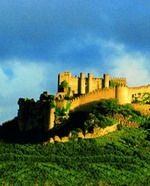 |
Pousada
de Óbidos Castelo de Óbidos
Style: Historic Design
Pousada w/pool in an old Castle
The Pousada de Óbidos,
Castelo de Óbidos, has been chosen as one of the 7 Wonders of Portugal.
This luxury hotel within the centuries-old beautiful castle walls that
encircle the village of Óbidos, was the first Pousada to be adapted
and restored from a historical monument. The original Manueline palace
in the castle’s northern wing was built by João de Noronha, count
of Dijon and alcaide of the town of Óbidos, at beginning of 16 C.
Óbidos is a first rate tourist attraction, known for its typical
white houses with blue trim, flowered windows, narrow streets and steps
paved with beautiful stone. |
| This
medieval village is very connected with all the history of Portugal. It
was on the XV century with Alphonse, IV count of Ourém that the
village became more important. In this nice place we can see lots
of monuments: the original Castle of the 17th century, the Mercy Church
from the 15th century, the Gothic Fountain, the Pillory. In 1755
with the terrible earthquake almost all the buildings were destroyed. |
|
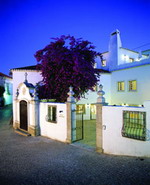 |
Pousada
de Ourém/Fátima, Conde de Ourém
Style: Historic Design
Pousada w/pool
Pousada Conde de Ourém
is situated one hour from Lisbon, two hours from Oporto, from Tomar only
half an hour and from 15 minutes from Fátima, one of Europe's main
pilgrimage destinations, more specifically in the middle of Portugal in
the historical village of Ourém. This historic luxury hotel
was built from a cluster of medieval houses, renovated with all modern
amenities. Wander through them and relive the days of old. From the
belvedere, enjoy the breathtaking view of the Seiça River Valley,
and catch a glimpse of the world-famous Sanctuary of Fátima. |
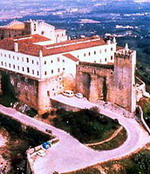 |
Pousada
de Palmela - Castelo de Palmela
Style: Historic Design
Pousada w/pool in an old castle
Pousada de Palmela, Castelo
de Palmela, was inaugurated in 1979 after the adaptation works to the Convent,
within the walls of the castle. With all its austerity, it is possible
to enjoy its interior in a comfortable way that preserves a lot of the
17th century. This historic luxury hotel is located on top of an
imposing hill, and it is one of the best architectural fortresses in Portugal,
specially known for its location and the magnificent views that it has
to offer. Palmela boasts excellent wines and superb cuisine, and
it is also the perfect starting place to discover the Costa Azul and the
magnificent Arrábida Natural Park. |
| Famous
for its palace in the rococo style, called "little Versailles". It's the
most welcoming of the royal palaces and built in the XVIII century. Its
gardens (Pensil or Neptuno and Azereiros), in the French way, are from
rare beautiful. It has lodging a lot of state-leaders visiting Portugal.
Queluz is served by countless roads and several public transportations
connecting to the capital (place of work of mostly inhabitants) and to
other places in the district. There are some industries and a growing commerce,
including malls and movie theatres. Besides the palace, there are
in Queluz some others interesting places that can have the attention of
the first visitors as some megalithic monuments (about 2500 BC) and some
buildings from the centuries XIV, XVII and XVIII. Around the old nucleus
of the city started to appear some villas and houses used to be summer
houses in the beginner of this century. |
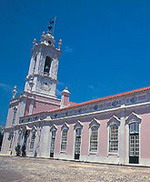 |
Pousada
de Queluz/Lisboa - Dona Maria I, Queluz
Style: Historic Design
Pousada w/pool formerly a palace
The Pousade de Queluz /
Lisbon, D. Maria I, is a historic luxury hotel located in the building
formerly used by the Royal Guard of the Court in the Palace of Queluz,
known as the "Portuguese Versailles". Besides the palace, there are
in Queluz some other interesting places that can have the attention of
the first visitors, as some megalithic monuments (about 2500 bC) and some
buildings from the centuries XIV, XVII and XVIII. Around the old nucleus
of the city started to appear some villas and houses that used to be summer
houses in the beginner of this century. The Pousada hotel privileged
location, about 5 km from Lisbon, 14 km from Sintra and 20 km from Cascais,
the attractive interior design and exacting recuperation of its little
private "theatre", combines with the exquisite cuisine of the Cozinha Velha
Restaurant. |
| São
Filipe's historical Pousada was installed at the fort with the same name,
and built in the late XVI century. It rises in a beautiful recess of the
river Sado, in its mouth, between the port of Setúbal and the narrow
peninsula of Tróia. To this inn we arrive through a passage that
crosses the thick walls of the fort, allowing to travel the totality of
the rampart and to appreciate the neighbor's panoramic Saws of Arrábida,
of the estuary of Sado and the Atlantic. A construction of the fort it
is due to Filipe I from Portugal and II of Spain. The beginning of
the works date of 1582 and it had as purpose to defend the setubalense´s
borough, through the control of the bar’s entrance where the fort of Outão,
with origin in the century XIV, represented the main piece. |
|
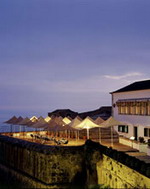 |
Pousada
de Setúbal - São Filipe, Setúbal
Style: Historic Design
Pousada w/pool in an old castle
São Filipe's historical
Pousada is installed in a fort from the late XVII century built by King
Philip II of Spain (Philip I of Portugal). This historic luxury hotel has
a breathtaking view over the River Sado estuary from its terrace.
Beside the terrace, Pousada de Setúbal, Sâo Filipe, counts
with several other attractions, such us a bar, a living room for social
encounters, a small gambling room and a dining room. Regarding the
city of Setúbal, it is one of Portugal's main ports, also offers
beautiful walks within the historic centre and surroundings, such as Sado
river beaches or the Arrábida montain range. |
Western
& Central Europe
| Home
Page | Andorra
| Austria
| Belgium
| Cyprus
| Denmark
|
England
| Finland
| France
| Germany
|
Greece
| Iceland
| Ireland
| Italy
| Luxembourg
| Malta
| Monaco
| Netherlands
| Norway
| Portugal
| Scotland
| Spain
| Sweden
| Switzerland|
Wales
|
Eastern
Europe
| Bosnia
and Herzegovina | Bulgaria
| Croatia
| Czech
Republic | Estonia
| Hungary
| Latvia
| Lithuania
| Macedonia
| Poland
| Romania
| Russia
| Slovak
Republic | Slovenia
| Ukraine
| Yugoslavia
|
Copyright © All Europe
Accommodation
Latest update: May 10, 2010
|